
- Walk In Anytime · No Appointment
Sprain and Strain Treatment in Houston, Open 24/7
A rolled ankle that will not bear weight, a knee that gives way, a wrist that swells after a fall, or a neck that stiffens after a crash can all look like a simple sprain. Some are. Others hide a broken bone or a torn ligament. Our emergency physicians test the joint, order an X-ray when the findings call for one, and send you home supported with a clear plan.
Open 24/7, Even Holidays
No Appointment Needed
0 Min Wait Time
Experienced ER Team
Sprain or something worse? A quick check
Go to an emergency room after a twist, fall or collision if you cannot take four steps, the joint feels loose or gives way, you heard a pop followed by fast swelling, or the area is numb. Most true sprains and strains are not dangerous, but only an exam can separate them from a fracture or a torn ligament that needs a specialist.
Call 911 right away
- Neck or back injury with numbness, weakness, trouble walking or loss of bladder or bowel control
- A head injury with confusion, repeated vomiting or passing out, along with neck pain
- A limb that looks out of place and is pale, blue or cold
- Bone showing, or bleeding that will not stop with firm pressure
Come to NorthStar now
- You cannot take four steps on an injured foot, ankle or knee
- The joint feels loose, locks or gives way
- A pop or snap was followed by quick swelling or deep bruising
- Numbness, tingling, or fingers and toes that look pale or feel cold
- A bump on top of the shoulder, or wrist pain after falling on your hand
- Neck or back pain after a crash or hard fall, even if it seems mild
May be able to wait for a doctor visit
- Mild swelling with normal color and feeling
- You can walk with a limp or use the hand with mild pain
- A finger that bends and straightens fully and looks straight
- Pain that eases clearly within two to three days
What counts as a sprain, a strain and a real emergency
People search for a pulled muscle, a twisted joint or a torn ligament and mean the same thing: something hurts after a movement went wrong. What matters in the ER is which tissue is injured and whether the joint is still stable.
- Ankle, foot and toe sprains, including rolled ankles and turf toe
- Knee ligament injuries after a twist or a sideways blow
- Shoulder, elbow and wrist sprains from falls and collisions
- Finger and hand sprains from jams, catches and falls
- Pulled hamstring, groin, calf and back muscles
- Neck and back sprains, including whiplash after a crash
How bad is it? Grades from mild to complete tear
The grade guides the brace, the crutches and how quickly you should see a specialist.
| Grade | Sprain (ligament) | Strain (muscle or tendon) | Usual ER path | Urgency |
|---|---|---|---|---|
| Grade 1, mild | Ligament is stretched, with tiny tears at most. The joint stays stable. | Muscle fibers are overstretched. Soreness and tightness, with strength close to normal. | Exam, wrap or brace, pain control, early gentle movement | Same day |
| Grade 2, moderate | Partial tear. The joint feels somewhat loose and walking hurts. | Partial tear. Clear weakness, bruising and pain when stretched. | Splint, boot or hinged brace, crutches or sling, follow-up within days | Come now |
| Grade 3, severe | Complete tear. The joint is unstable and often gives way. | Muscle or tendon torn through. A gap, bulge or loss of function may show. | Immobilization, X-ray to rule out a fracture, specialist referral, surgery in some cases | Come now |
| Red-flag injury | The joint looks out of place, or the hand or foot below it is numb, pale or cold. | Back or neck pain with leg weakness, numbness or loss of bladder or bowel control. | Emergency evaluation and, when needed, transfer for surgical or spine care | Emergency |
Common sprains and strains, and how each one is treated
The joint decides which ligament we test, which support we use and how quickly a specialist should see you.
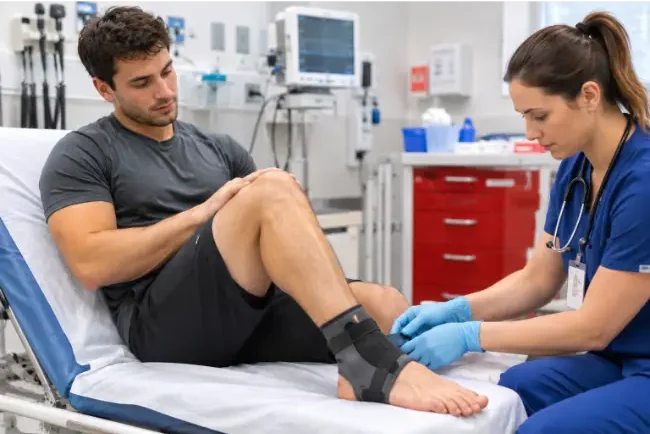
Ankle
Ankle sprain treatment uses the Ottawa rules to determine if an X-ray is needed. Mild sprains require a brace and gentle movement, while severe sprains may need a boot and crutches. High ankle sprains heal more slowly and require specialist evaluation.
Come now

Foot and big toe
Sprained foot treatment starts with checking for fractures. Once ruled out, treatment includes a supportive shoe or boot, taping and rest. Turf toe treatment involves a stiff-soled shoe and taping for mild injuries, while severe tears may require a walking boot, crutches or surgery.
Come now

Knee
MCL sprain treatment typically involves a hinged brace, crutches and gentle exercises, rarely requiring surgery. LCL sprains often need specialist evaluation due to possible additional injuries. Knee locking, instability or rapid swelling requires a thorough examination.
Come now
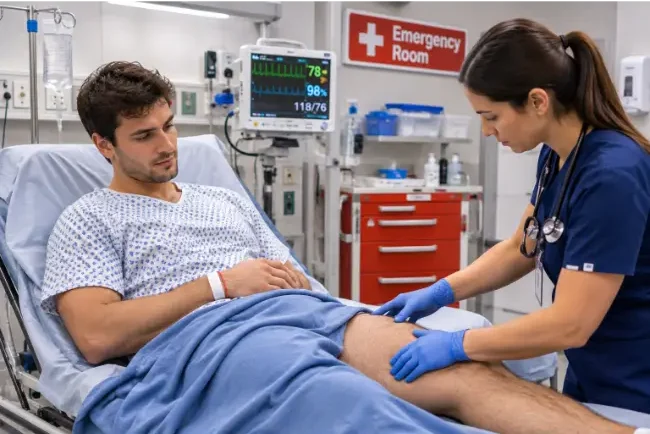
Hip, thigh and leg
Hip and leg sprain treatment begins with identifying the injured muscle or ligament. Mild strains may heal within days, while severe tears can take months or require surgery. A painful, swollen or warm calf may indicate a blood clot and requires urgent medical evaluation.
Same day

Shoulder and upper arm
AC sprain treatment typically involves a sling, cold packs and pain relief, while severe shoulder separations may require surgery. Arm sprain treatment includes examining the shoulder, elbow and wrist to identify the affected joint.
Come now
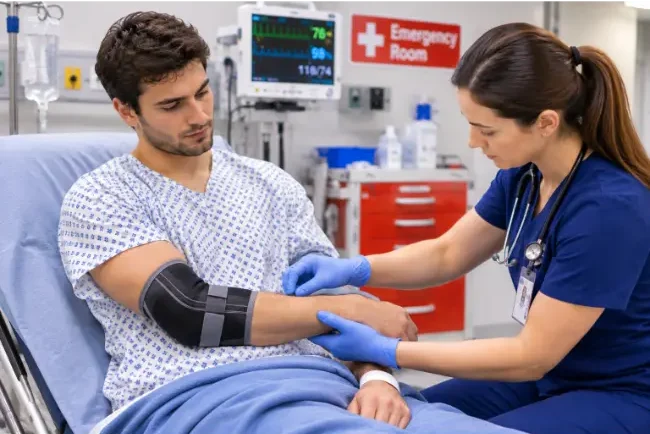
Elbow
Elbow sprain treatment depends on the affected ligament. Mild UCL sprains typically require rest, ice, pain relief and physical therapy, while complete tears may need surgery. Elbow deformity or a numb or pale hand requires immediate emergency care.
Come now

Wrist
Wrist ligament treatment depends on bone alignment and injury severity. Mild sprains require splinting and rest, while serious tears may need specialist care. Thumb-side pain may indicate a hidden fracture, making follow-up essential even after normal X-rays.
Come now

Hand and fingers
Sprained hand and finger treatment involves ruling out fractures, splinting or buddy taping, and gentle movement to prevent stiffness. Crooked, immobile, cold or numb fingers require immediate medical evaluation. Never force an injured finger straight.
Same day

Neck and back
Neck and back sprain treatment begins with ruling out serious injuries. Most sprains improve with pain relief and gentle movement. Saddle-area numbness, loss of bladder or bowel control, or weakness in both legs requires immediate emergency care.
Come now
Your visit, step by step
No appointment and no referral. This is the usual order of care.
Check-in and triage
A nurse records vital signs, pain level and how you were hurt. Trouble bearing weight, numbness, or neck and back pain after trauma moves you up the line.
Physician exam
The physician checks swelling, tenderness, motion and stability, compares the injury with your healthy side, and tests pulses and feeling.
Testing, only if needed
X-rays are ordered when findings call for them, such as pain over a bone or failing four steps. Many soft-tissue injuries need no imaging at all.
Support and pain relief
A wrap, brace, splint, boot or sling is fitted, crutches are adjusted, and pain medicine is chosen to suit your health history.
Discharge plan
You leave with written care steps, when to start moving, warning signs and a follow-up plan. If you need a specialist or hospital care, we arrange it.
Sprain treatment in the ER, and what comes after
Support that fits the injury
Wraps and lace-up braces for mild sprains, stirrup splints and walking boots for moderate ankle injuries, hinged braces for knees, slings for shoulders and finger splints or buddy tape for hands. Crutches are fitted and practiced before you leave.
Pain and swelling control
Elevation, cold packs when they help, and medicine chosen for you. Acetaminophen, an anti-inflammatory or something stronger may be used, after we check for stomach, kidney and blood thinner concerns.
Early movement, not long rest
Most mild and moderate injuries do better with a few days of protection followed by gentle, guided movement than with weeks of immobilization. You get simple motion exercises and a timeline for adding weight.
When more than ligaments are hurt
If a joint has also slipped out of place, the physician puts it back and checks circulation and feeling again afterward. Small cuts are cleaned, and any fracture found is splinted and referred.
Your nearest ER for sprains and strains in Northwest Houston
- Cypress
- Willowbrook
- Jersey Village
- Klein
- Bammel
- Spring
- Tomball (southern portion)
Coming from further away? If the injury involves the head, neck or spine, call 911 so paramedics can protect the spine on the way.
Visit Us
Address
9920 Cypresswood Dr Houston, TX 77070
Hours
Open 24 Hours · Every Day of the Year
Phone
[PHONE]
Helpful Information
Questions people ask before they come in
Should I go to the ER for a sprain?
Go if you cannot take four steps, the joint feels loose or gives way, you heard a pop followed by fast swelling, or the area is numb, pale or cold. Neck and back injuries after a crash or fall also belong in an ER. A mild sprain with normal feeling and easing pain can wait for a doctor visit.
What is the difference between a sprain and a strain?
A sprain is an injury to a ligament, the tissue that connects one bone to another. A strain is an injury to a muscle or tendon, which links muscle to bone. Both are graded one to three by how much tissue is torn. Many people say muscle sprain, but doctors call that a strain.
Do I need an X-ray for a twisted ankle?
Not always. Physicians use the Ottawa ankle rules, which call for an X-ray when you have pain near the ankle bones plus bone tenderness or you cannot take four steps. If neither applies, a fracture is unlikely and care focuses on support and early movement. The rules screen for fractures and do not diagnose a sprain.
Is it better to go to the ER or urgent care for a sprain?
Choose the ER for severe pain, deformity, numbness, an unstable joint, or any neck or back injury after trauma. For a mild sprain with normal color and feeling, either can work. NorthStar is a licensed emergency room and not an urgent care center, and billing differs. Sprain and strain treatment here starts with a full emergency physician exam.
Should I use ice, heat or compression on a sprain?
Compression and elevation help control swelling in the first days, and ice can ease pain for 15 to 20 minutes at a time with a cloth between the ice and your skin. Heat is usually saved for later stiffness once swelling has settled. Ask the physician which pain medicine suits you, since advice on anti-inflammatory drugs varies.
What is a high ankle sprain, and why does it take longer to heal?
A high ankle sprain injures the ligaments that hold the two lower leg bones together, just above the ankle joint. Every step stresses them, so healing is slower than for the common outer ankle sprain. Pain sits higher, swelling can be mild, and a walking boot with specialist follow-up is common.
Does a torn ligament always need surgery?
No. Most partial tears and many complete tears heal with bracing, protection and therapy, including most MCL injuries and AC joint grades I to III. Surgery is more likely for an unstable joint, several injured ligaments, a high-grade shoulder separation or a complete UCL tear in an athlete. A specialist makes that call.
When is neck or back pain after an injury an emergency?
After a crash or hard fall, any neck pain deserves an ER exam because symptoms can appear hours later. Call 911 for numbness, weakness, trouble walking or loss of bladder or bowel control. Most cervical and lumbar strains settle with time, but these red flags can mean a fracture or cauda equina syndrome.
How long does a sprained ankle take to heal?
A mild sprain often settles in one to two weeks. Moderate and severe tears take several weeks to a few months, and high ankle sprains take longer. Good ankle sprain treatment protects the joint for a few days, then adds gentle movement, strengthening and balance work to prevent another roll.
Walk In · No Appointment · Open Now
Do not guess whether it is a sprain
Walk in at any hour for sprain and strain care in Houston. If the injury involves your head, neck or spine, call 911 first.